Content Gap Analysis: A Practical Guide
Comparing your topics with your competitors' is the most reliable way to plan content. Here is how to run one and which gaps to ignore.

A content gap analysis compares what your competitors cover with what you cover, and lists the topics they answer and you do not. It is the most reliable way to plan content, because every idea on the list is already proven to matter to someone in your market.
It is also easy to do badly. A list of 200 "gaps" is not a plan, it is a way to feel busy. This guide covers how to run one and — more importantly — how to decide which gaps deserve an article.
Why start with competitors instead of keywords?
Keyword tools give you volume without context. They will happily tell you that "SEO" gets a million searches a month, which is useless to a plumber in Manchester.
Competitors give you something better: evidence. If three businesses like yours all wrote about a subject, that subject has demand in your market. Someone already tested the idea.
How do you find out who your competitors actually are?
Most business owners name the wrong ones. The firm you compete with for customers is often not the one you compete with in search results, and it is the second list that matters here.
Find it the direct way: search the three or four phrases you most want to rank for, in an incognito window, and write down who appears on the first page. Ignore directories, marketplaces and news sites — you are looking for businesses like yours.
Do it for a commercial phrase ("emergency plumber Bristol") and an informational one ("why is my boiler leaking"). The two lists are often different, and the informational one is where the content gaps live.
If the same two or three names keep appearing across both, those are your search competitors, whatever you think of them commercially.
How do you run one manually?
You do not need a tool to start. You need an afternoon.
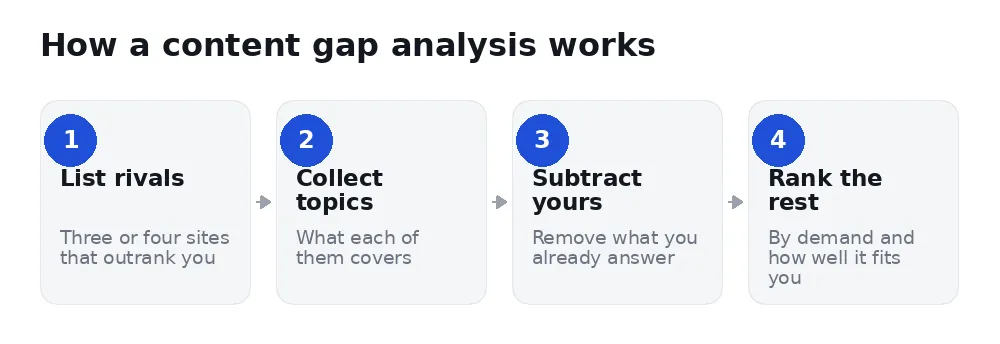
1. Pick three or four real competitors. Not the national giants — businesses roughly your size who show up when you search the terms you want. Beating Wikipedia is not a plan.
2. Read their blog and service pages. Write down the question each page answers, not the title. "Do I need to leave my home during treatment?" is a topic. "Our Services" is not.
3. Cross off what you already cover. Be honest here. A passing mention in a paragraph is not coverage; a page that answers the question is.
4. Rank what remains. Which of these do your customers actually ask you?
That last question is the one that matters, and it is the one no tool can answer for you.
Which gaps are worth writing?
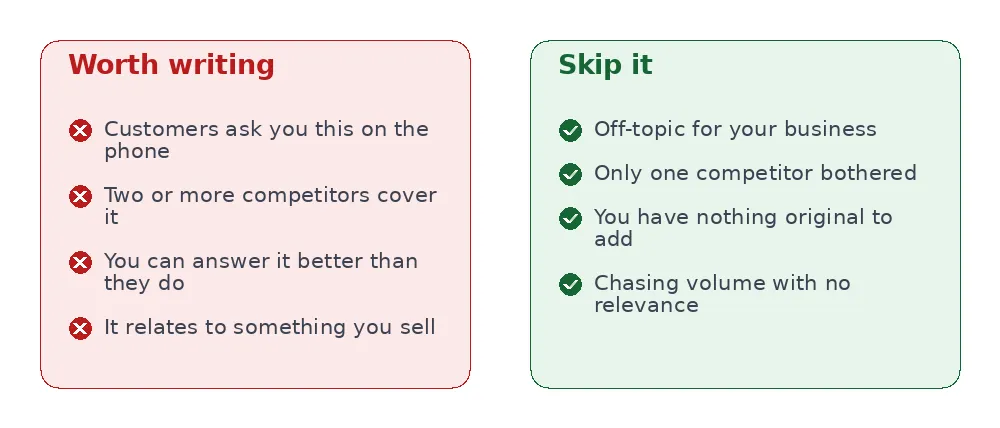
The strongest candidates share three traits: customers genuinely ask about it, more than one competitor covers it (one may just have been wrong), and you can say something they cannot — your prices, your process, your local knowledge.
That third trait is what makes a page worth ranking. A gap filled with a generic article is a page that exists; a gap filled with what you know from doing the work is a page that wins.
What about the gaps you should ignore?
Some gaps exist because your competitor made a mistake. They wrote about something off-topic, chased a keyword with no commercial relevance, or published filler to hit a quota.
Copying that is copying their mistake. The question is never "do they have it and I don't" — it is "would this bring me the right visitor".
How many pages should you plan?
Fewer than you think. Ten genuinely useful pages beat fifty thin ones, and the thin ones actively hurt: they dilute your site, compete with each other, and signal a site that publishes for search engines rather than people.
A realistic pace for a small business is one good page a month. Sustained for a year, that is twelve solid assets — far more than most competitors manage.
What do you do after the analysis?
Turn the shortlist into a queue and work it in order. Before writing each page, fill in a five-line brief:
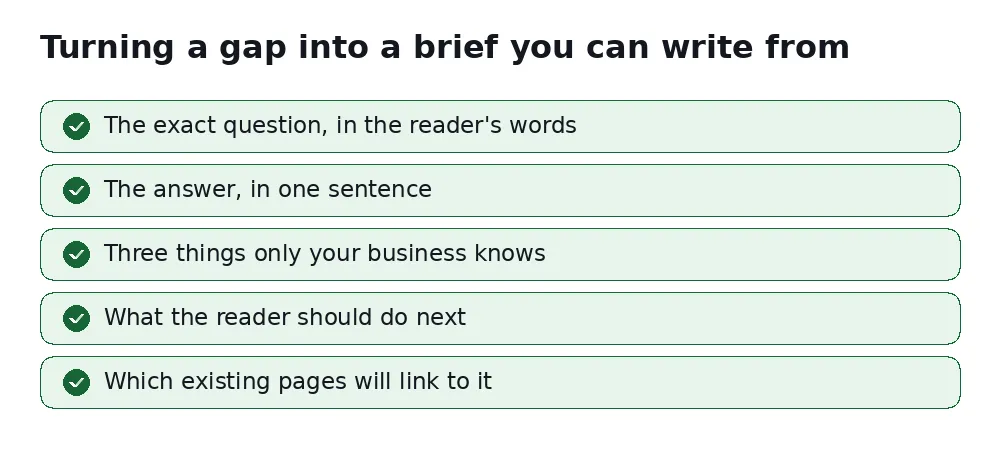
The third line is the one that decides whether the page is worth writing. If you cannot name three things only your business knows — a price, a case, a local constraint, a mistake you see customers make — the page will be a generic article competing with other generic articles, and generic loses.
Finding that out before spending three hours is the point of writing a brief at all.
A worked example
A removals company runs the analysis and finds a gap: two competitors have pages about moving with pets, and it has nothing.
The brief writes itself:
- Question: "How do I move house with a cat without traumatising it?"
- Answer in one sentence: Keep the cat in one closed room until the van is loaded, move it last, and set up a single familiar room first at the new house.
- What only we know: what actually goes wrong on moving day (cats escaping through propped-open front doors), which of our vans have climate control, and that we schedule pet households first thing in the morning.
- Next step: request a quote, mentioning pets so we book the right slot.
- Links from: the main removals page and the "moving checklist" post.
That page will beat both competitors, not because it is longer, but because two of the five lines contain information a competitor physically cannot copy.
How do you know whether it worked?
Note the date you publish. Six to eight weeks later, open Search Console, filter to that page, and look at impressions before clicks. Impressions rising means Google has understood the topic and is testing you; clicks follow once your position improves.
If after two months a page has almost no impressions, the problem is usually demand rather than quality — nobody is searching for it in your area. That is useful to learn, and it is a reason to check the next gap against real customer questions rather than a competitor's enthusiasm.
How often should you repeat it?
Twice a year is plenty. Content moves slowly; competitors do not reinvent their sites monthly. Running it constantly produces the same list with different ordering, and a plan you never finish.
FAQ
Is a content gap analysis the same as keyword research?
No. Keyword research starts from search demand; a gap analysis starts from what proven competitors cover. They complement each other — the gap tells you the topic, keyword data can refine the angle.
How many competitors should I compare against?
Three or four. More produces a longer list without better decisions, and every extra competitor adds topics that are less relevant to you.
Should I write longer articles than my competitors?
Not as a goal. Longer only helps when the extra length is extra usefulness. A 700-word page that answers the question fully beats a 3,000-word page padded to look thorough.
What if a competitor covers everything I do?
Then the opportunity is depth or honesty rather than breadth: real prices, real cases, real photographs, the things a generic guide never has.
Find your own gaps
SerpCue's Content Gap crawls the competitors you name, extracts the topics they cover from real page content — not just titles — and shows what is missing from your site, with the actual competitor URLs so you can judge each one yourself. You can dismiss anything irrelevant and it will not come back.