GEO vs SEO: What Actually Changed in 2026
About 80% of "generative engine optimisation" is ordinary SEO with a new name. Here is the part that genuinely differs, and what to do about it.
GEO — generative engine optimisation — is the work of getting your content used by AI assistants like ChatGPT, Claude, Perplexity and Google's AI Overviews. The honest summary is that roughly 80% of it is ordinary SEO you should be doing anyway, and about 20% is genuinely different.
Plenty of people are selling the 20% as if it were a whole new discipline. This article separates the two, so you know what actually deserves new effort.
What is identical to normal SEO?
Almost all of the technical foundation, because assistants and search engines need the same things:
- Your text must be in the HTML. Search engines render JavaScript; most AI crawlers do not. So this matters more for AI, not less.
- Structure has to be clear. One H1, meaningful H2s, short paragraphs. Both machines use headings to understand what a page covers.
- The page has to be reachable. No accidental
noindex, no robots.txt block, a working sitemap. - The content has to be genuinely useful. Thin pages assembled for keywords do not get cited any more than they rank.
If someone offers you a "GEO audit" that only checks these, you are being sold an SEO audit with a new label.
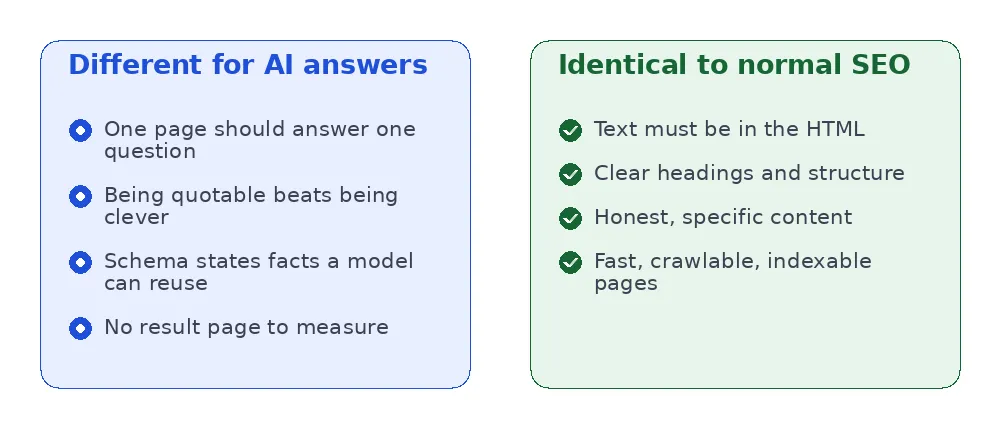
What genuinely differs? (1) Being quotable
A search engine ranks a page. An assistant assembles an answer from a few sources and links them. That changes what "good" looks like.
A model can lift a clean, self-contained statement of fact. It struggles with a paragraph that builds an argument over five sentences before reaching the point. So state the answer first, then explain it — the opposite of the SEO-blog habit of 400 words of preamble before the recipe.
Concretely: if a section is titled "How much does a treatment cost?", the first sentence should contain the price range. Everything else can follow.
What genuinely differs? (2) Facts a machine can reuse
Schema.org markup matters more here than it did for classic rankings. When an assistant needs to tell someone your opening hours, an Organization or LocalBusiness block gives it a fact rather than an inference.
This is also why identity markup is worth adding even for small sites: it is how a model becomes confident enough to name you rather than hedging.
What genuinely differs? (3) You cannot measure position
This is the uncomfortable one. In search there is a result page: you are 4th, and anyone can verify it. In an assistant there is no such thing. The same question produces different answers for different people at different times.
So the metric you are used to simply does not exist. Some tools sell "AI rank tracking" anyway, by asking a chatbot repeatedly and logging mentions. Understand what that number is: a sample of a non-deterministic system, not a ranking.
What you can measure honestly is your referral traffic from AI tools (in analytics, ChatGPT and Perplexity show up as referrers) and the mechanical readiness of your site.
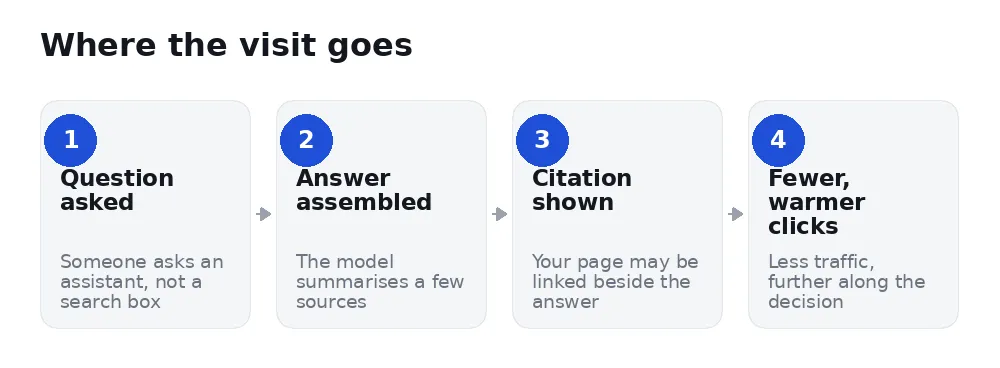
Does this mean less traffic?
For informational queries, quite possibly. If someone asks "what temperature kills bed bugs" and gets the answer in the chat, they were never going to buy anything on that visit anyway.
What tends to survive is traffic with intent behind it — people comparing options, checking prices, looking for someone local. Those visits are fewer and further along the decision, which is not the disaster the headlines suggest, but it does mean thin informational content ages badly.
So what should you actually do?
- Check that AI crawlers are not blocked in robots.txt. This is the single highest-impact thing and takes a minute.
- Make sure your text is in the HTML, not only rendered by JavaScript.
- Add Organization or LocalBusiness schema so your identity is a fact, not a guess.
- Rewrite your top pages to answer first, then elaborate.
- Ignore anyone selling guaranteed AI rankings. They cannot deliver it, because the thing they are promising is not measurable.
FAQ
Is GEO a real discipline or marketing?
Both, honestly. The underlying shift is real. The packaging of it as a separate service with separate fees is mostly marketing, because the work overlaps so heavily with SEO.
Should I stop doing SEO?
No. Google still sends far more traffic than every assistant combined, and the work that helps one largely helps the other.
Do I need special AI tools?
For the mechanical checks, no — you can read robots.txt yourself and view source. Tools save time, not capability.
Check where you stand
Our free page check covers the mechanical half in a few seconds: crawler access, whether your text survives without JavaScript, and what structured data you publish. No sign-up, and it shows every finding rather than hiding them behind an upgrade.