Is AI-Written Content Bad for SEO?
Google does not penalise content for being AI-written. It penalises content made to game rankings. Here is where AI content actually fails.

No — Google does not penalise content for being written by AI. It penalises content that exists to manipulate rankings rather than help people, regardless of who or what produced it. That distinction is the entire answer, and it has been Google's stated position since its guidance update in 2023.
We build an AI writer, so treat this as an interested party being straight with you: AI content fails often, just not for the reason most people assume.
What does Google actually say?
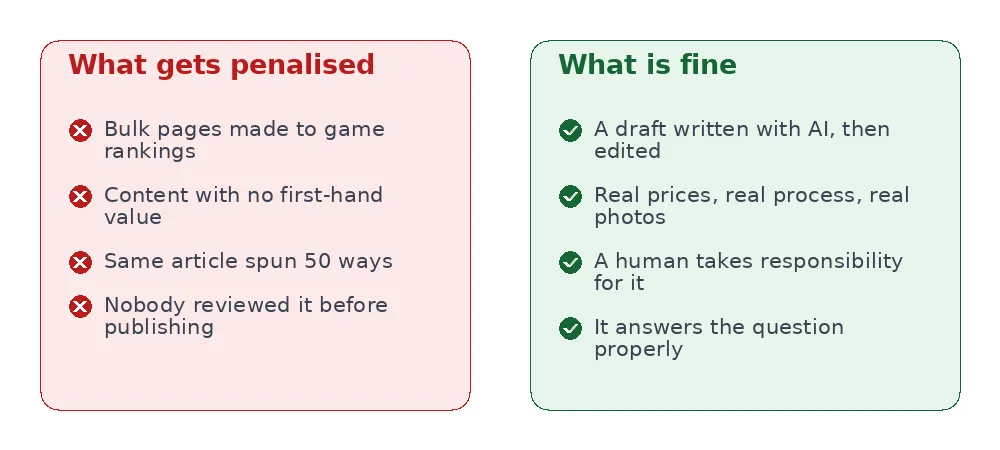
Google's guidance is that it rewards high-quality content "however it is produced". The concern named in its spam policies is scaled content abuse — generating many pages primarily to game search rankings, with no regard for whether they help anyone.
The practical translation: the method of production is not the test. The purpose is. A thousand near-identical pages spun to catch keyword variations is abuse whether a human or a model typed them. A carefully edited guide that answers a real question is fine either way.
So where does AI content actually fail?
In our experience it is rarely detection. It is these, in order:
1. It knows nothing your competitors don't. A model writes from general patterns. Ask it about pest control and you get accurate, generic advice that fifty other sites already published. Nothing about that page earns a link, a citation, or a customer.
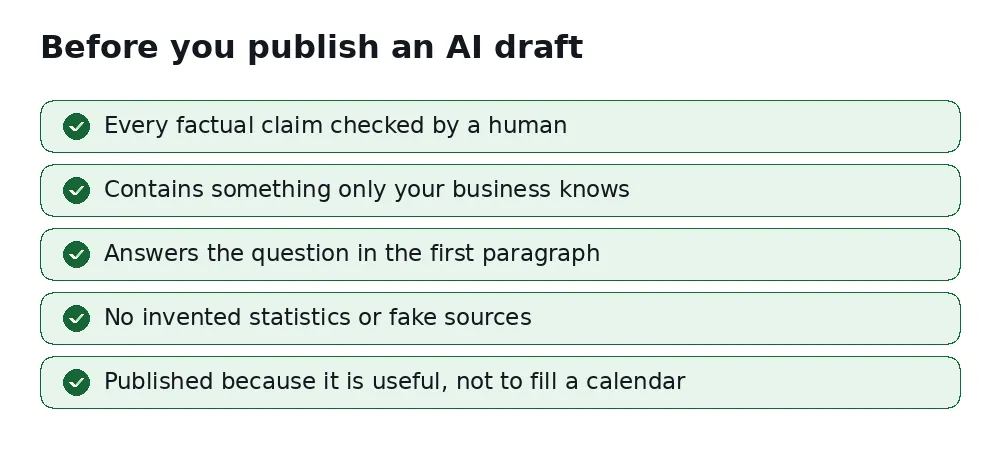
2. It invents things. Confident, specific, wrong. Statistics with no source, studies that do not exist, prices it made up. Publishing that unchecked is how you lose trust with a reader who knows the subject.
3. It gets published because the calendar said so. Volume becomes the goal. Twenty thin posts nobody needed dilute a site that had five good ones.
4. Nobody owns it. If no person reviewed it, no person can stand behind it — which is exactly the "no first-hand expertise" signal quality raters are trained to notice.
What about AI detectors?
They are not reliable, in either direction. They flag human writing as AI (particularly from non-native English speakers, whose sentence patterns are more regular) and clear AI text as human. Google has never said it uses one as a ranking signal, and building a content strategy around beating a detector is optimising for the wrong thing entirely.
The useful question is not "will this be detected". It is "does this page deserve to exist".
What does a workflow that holds up look like?
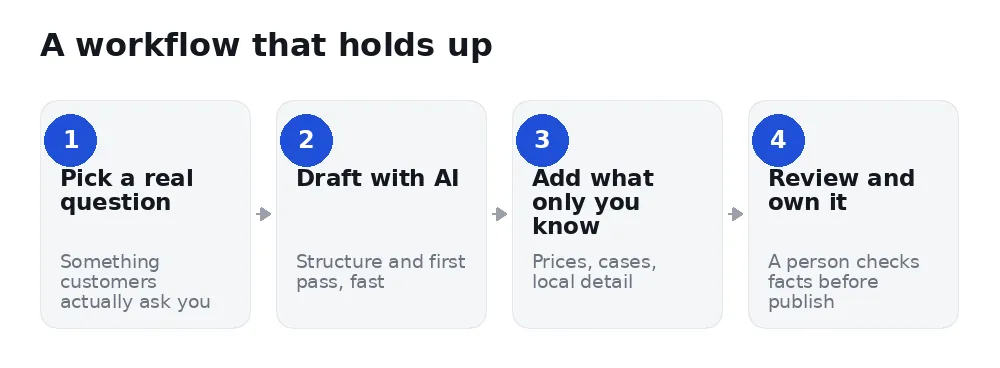
Start from a real question. Not a keyword with search volume — something customers ask you on the phone. Your inbox is a better content plan than any keyword tool.
Let AI do the draft. This is what it is genuinely good at: structure, a competent first pass, getting past the blank page. It saves hours.
Add what only you can add. Your actual prices. What went wrong on a job last month. Why the standard advice does not apply to old buildings in your city. Photos you took. This is the step that decides whether the page is worth anything, and it is the step people skip.
Check the facts, then own it. Every number, claim and name verified by a person before publishing.
Does AI content get cited by ChatGPT and Perplexity?
Same principle. Assistants cite sources that state things clearly and specifically. Generic AI-written filler is the least citable content there is, precisely because the model could produce it without you.
Specific, verifiable, first-hand information is what gets quoted — which puts the incentive in exactly the same place as the Google guidance.
FAQ
Do I have to disclose that AI helped?
Google does not require it. Some audiences appreciate it. A byline naming a real person who reviewed the piece is more valuable than a disclaimer.
Can I publish AI content without editing it?
You can. It rarely ranks, rarely converts, and occasionally embarrasses you with an invented fact. The editing is the part that creates the value.
How much AI content is too much?
Wrong question. One useless page is too many; a hundred genuinely helpful ones are fine. Judge pages by whether they help, not by their origin.
Will Google's position change?
It has been consistent for years: quality over provenance. Even if the wording changes, "publish things that genuinely help people" has never been the losing bet.
Write drafts you can stand behind
SerpCue's AI writer starts from topics your competitors cover and you do not, links only to pages we actually verified on your site, and always saves as a draft — never publishing without you. The point is to remove the blank page, not the person. See it in the plans.