How to Increase Website Traffic With SEO: 10 Practical Steps
A practical guide to increasing organic traffic by improving pages that already have demand, not by publishing random content.

To increase website traffic with SEO, start with pages and topics that already have search demand, then improve the page until it deserves more impressions and clicks. The best SEO traffic plan is not ???publish more.??? It is: find opportunity, improve the right page, connect it with internal links, and measure the result.
Most site owners make SEO traffic harder than it needs to be. They publish a batch of random blog posts, wait, get disappointed, and assume SEO does not work. The better path is slower on paper but faster in practice: use data to choose where effort can actually move traffic.
This guide gives you a practical order. It works for small business sites, service sites, SaaS sites, and content sites. You do not need an agency to start. You need a clear way to decide what to improve first.
Table of contents
- How do you find pages with existing search demand?
- Which SEO traffic opportunities should you choose first?
- How do you refresh content to earn more traffic?
- How do content clusters increase SEO traffic?
- How do titles and descriptions increase clicks?
- What technical blockers reduce SEO traffic?
- How do you measure SEO traffic growth?
- What is a simple 30-day SEO traffic plan?
- FAQ
How do you find pages with existing search demand?
Start in Google Search Console. Look for pages with impressions. Impressions mean Google is already showing the page sometimes. That is valuable because you are not starting from zero.
Sort by impressions and look at queries for each page. Which searches is the page appearing for? Are those searches relevant to the business? Is the average position close enough to improve? Is the click-through rate lower than expected?
A page with 5,000 impressions and almost no clicks may need a better title, stronger meta description, or clearer match to intent. A page ranking in positions 8 to 20 may need a better answer, more useful sections, and stronger internal links. A page with no impressions may need keyword research or more time.
If you do not have Search Console connected, use your current analytics, customer questions, and existing sales pages to make a first list. But connect Search Console as soon as possible. It is the free data source that tells you where Google already sees your site.

Which SEO traffic opportunities should you choose first?
Choose pages where effort can realistically change the result. A page with impressions, a relevant query, and an average position near page one is usually a better first project than a brand-new post for a huge keyword.
Use a simple scoring system. Business value matters. Search demand matters. Current position matters. Page quality matters. Effort matters. A page that can bring qualified leads should beat a page that only brings curiosity traffic.
Do not only chase volume. A search with 200 monthly visitors and high purchase intent can be more valuable than a broad informational keyword with 10,000 searches and no buying context. For a local business, ???emergency electrician in Austin??? is usually more valuable than ???electricity tips.???
This is where SerpCue's Google Search Console SEO workflow fits naturally: Search Console gives the raw data, but you still need to turn that data into next actions.
How do you refresh content to earn more traffic?
Refreshing content does not mean changing the date and adding a paragraph. A real refresh makes the page more useful for the searches it already appears for.
Start by comparing queries to the page. If people search for examples, add examples. If they search for a checklist, add a checklist. If they search for pricing, give pricing context where appropriate. If the page ranks for beginner questions, explain terms in plain English.
Improve the introduction. Many pages lose visitors because they take too long to answer the question. Put the direct answer in the first 100 words. Then expand with details, steps, and examples.

Update internal links at the same time. A refreshed page should link to related pages and should receive links from related pages. Search engines use those links to understand how the page fits into the site.
If you want examples of page-level improvements, read the practical SEO tips for site owners and the guide to improving website SEO without an agency. Those are good companion pieces for prioritizing changes.
How do content clusters increase SEO traffic?
Content clusters help search engines and visitors understand that your site covers a topic deeply. A cluster usually has one broad page and several focused support pages.
For example, a DIY SEO cluster might include a broad guide, a keyword research article, an internal linking article, a technical SEO article, and a page about checking rankings. Each page answers one intent, and each page links to the others where useful.
The mistake is writing five posts that all say the same thing. That creates cannibalization. The better approach is to give each page a job. One page explains the process. One page gives a checklist. One page diagnoses traffic drops. One page covers technical fixes.
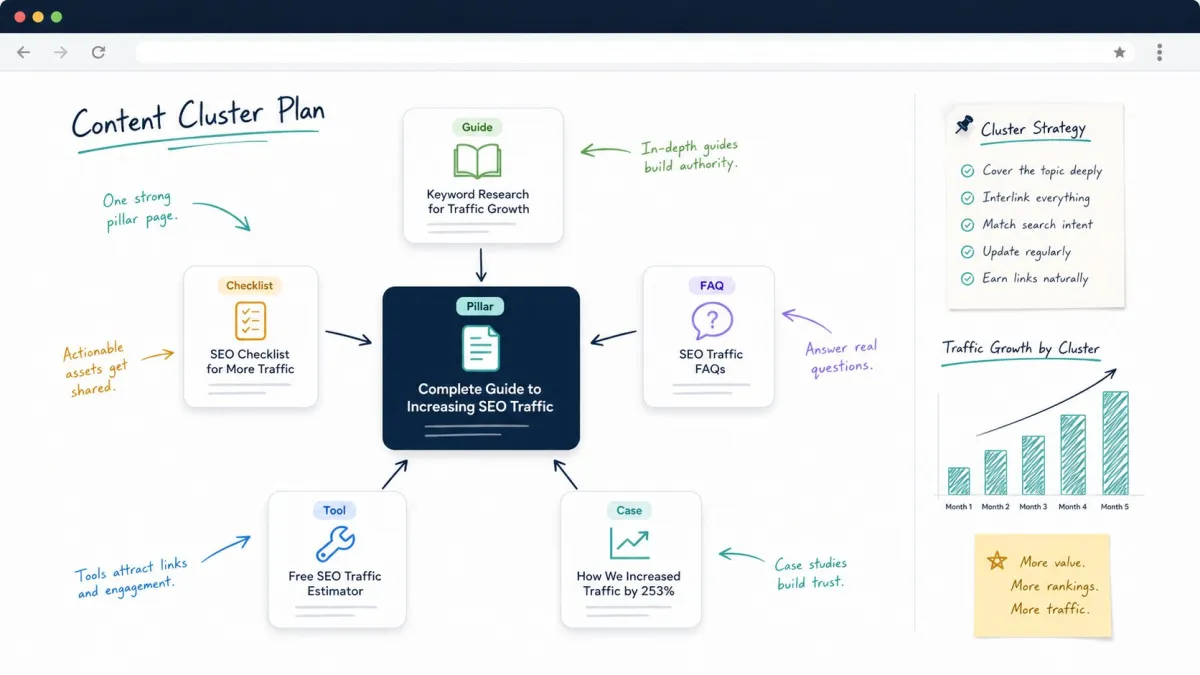
Before publishing a new article, check whether an existing page should be improved instead. If the topic is a subtopic of an existing article, add a section or create a more specific support page. If the intent is different enough, publish a new page and link it from the relevant hub.
How do titles and descriptions increase clicks?
Traffic is not only rankings. If a page already appears in search results but people do not click, improving the title and description can increase traffic without changing the ranking dramatically.
A good title is specific. It names the topic, includes the main phrase naturally, and gives a reason to click. A weak title is generic, too long, or written only for the business owner instead of the searcher.
The meta description should preview the benefit. It should not stuff keywords. It should tell the searcher what they will learn or solve. Google may rewrite descriptions, but writing a useful one still helps you clarify the page.
Look for pages with high impressions and low CTR. Those are your click opportunities. Improve one page at a time, record the change date, and review CTR after enough data accumulates.
What technical blockers reduce SEO traffic?
Technical blockers can limit traffic even when content is good. Common issues include accidental noindex tags, blocked pages, redirect chains, broken internal links, slow hero images, poor mobile layout, duplicate titles, and canonical confusion.
Start with important pages. A minor warning on a tag archive is less urgent than a crawl error on a service page. A big image on a blog post may matter if it delays the largest contentful paint. A broken navigation link matters because it affects users and crawlers.
Use an SEO audit tool to find technical problems, but do not treat every warning equally. Fix issues that affect crawlability, indexation, user experience, or important pages first.
How do you measure SEO traffic growth?
Measure SEO traffic by page and query. Site-wide traffic can hide what is happening. One page may improve while another drops. One query may gain clicks while another loses impressions.
Track impressions, clicks, average position, and CTR before and after changes. If you refresh a page on July 23, compare the next few weeks with the previous period. Do not judge from one day.
Also measure business outcomes. More traffic is useful only if it brings the right visitors. Watch leads, signups, calls, demo requests, email subscribers, or product actions. SEO traffic should support the business, not just make a chart go up.
The most reliable way to increase website traffic with SEO is repeatable: choose a real opportunity, improve the page, connect it internally, measure, and repeat. That loop is less flashy than hacks, but it is how small sites build durable traffic.
What is a simple 30-day SEO traffic plan?
A simple 30-day plan keeps the work focused. In week one, connect Search Console, crawl the site, and choose five pages that either already get impressions or directly support revenue. Do not choose every page. Pick the pages where better search traffic would actually matter.
In week two, improve the first two pages. Rewrite titles if they are vague. Add missing sections based on real queries. Make the opening answer clearer. Add internal links from related articles and service pages. Compress any obvious heavy images. Record the exact date of each change.
In week three, work on one new content gap only if it is clearly different from existing content. If the gap is just a variation of a page you already have, update the existing page instead. New content should earn its place by answering a distinct search intent.
In week four, review early signals and choose the next cycle. You may not see full results yet, but you can often see whether pages were crawled again, whether impressions changed, and whether the improved pages are getting more relevant queries. That rhythm turns SEO into a manageable habit instead of a vague project.
FAQ
What is the fastest way to increase website traffic with SEO?
The fastest path is usually improving pages that already get impressions or rank near page one. Google already sees demand, so a better title, stronger answer, or internal links can move the needle.
How many articles should I publish each month?
Publish only as many as you can make genuinely useful. For many small sites, improving two existing pages and publishing one strong article beats publishing eight thin posts.
Can SEO increase traffic without backlinks?
Yes, especially for lower-competition and long-tail topics. Backlinks can help, but technical access, content quality, search intent, and internal links should be fixed first.