How to Improve Your Website SEO Without an Agency
A practical guide to improving SEO on an existing website by prioritizing pages, refreshing content, fixing technical issues, and measuring results.

How to improve SEO on an existing website: start with pages that already get impressions, fix the obvious on-page and technical problems, refresh content so it matches search intent, add useful internal links, and measure changes over the next few weeks. Do not try to improve everything at once. Improve the pages that can actually move.
That is the part most site owners need to hear. SEO improvement is not a heroic weekend where you rewrite the whole site, install three plugins, and emerge covered in spreadsheet dust. It is a repeatable process: find the weak spot, fix one useful thing, measure, and repeat.
This guide is for small business owners and site owners who want better SEO without immediately hiring an agency. It assumes you already have a website and want to make it perform better.
Table of contents
- What does improving SEO actually mean?
- How do you improve SEO step by step?
- Which pages should you improve first?
- How do you refresh content for better SEO?
- Which technical SEO improvements matter most?
- How do you measure SEO improvements?
- FAQ
What does improving SEO actually mean?
Improving SEO means making your site easier for search engines to crawl, easier for people to understand, and more useful for the searches you want to earn. It is not one thing. It is a combination of technical health, clear pages, helpful content, internal links, speed, and measurement.
The key word is "improving." You are not starting from a blank page. You are looking at what already exists and asking: which page could perform better if it were clearer, faster, deeper, better connected, or better matched to search intent?
That makes this different from a beginner setup guide. If you need the full starting workflow, read how to do SEO yourself. This article is about making an existing site stronger.
A good SEO improvement should do at least one of these things: help more pages get discovered, improve rankings for relevant queries, earn more clicks from existing impressions, help visitors continue to useful pages, or remove a technical problem that blocks performance.
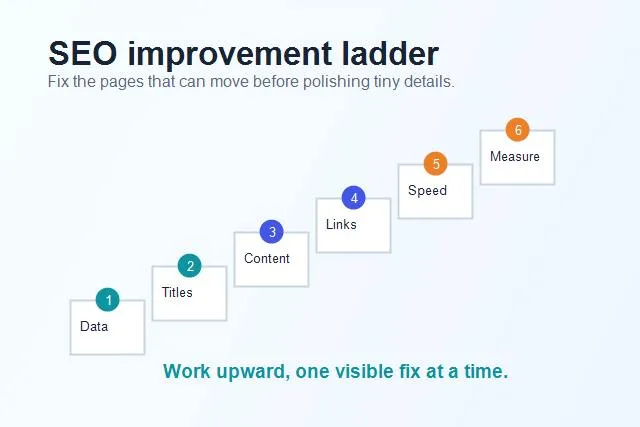
SEO improves faster when you work from real data toward the page fixes that visitors and search engines can feel.
How do you improve SEO step by step?
Start with data. Open Google Search Console and look for pages with impressions. A page with impressions already has a signal. Google has tested it for some searches. That makes it a better improvement candidate than a page nobody has ever seen.
Look for three patterns. First, pages ranking around positions 11-20. These are close enough that better content, stronger internal links, or clearer relevance may help. Second, pages with high impressions and low CTR. These may need better title tags and meta descriptions. Third, pages losing clicks over time. These need diagnosis before you start changing things.
Next, run an audit on the page. Check the title, H1, headings, meta description, image alt text, internal links, broken links, page speed, indexability, and whether the page actually answers the search intent. SerpCue's small business SEO workflow is built around this kind of practical prioritization: show the issue, then decide what to fix next.
Then make one focused improvement. Do not change five major things at once if you want to learn what worked. If the title is weak, improve it. If the page is thin, add the missing sections. If the page has no internal links pointing to it, add relevant links from related pages. If it loads slowly, fix the biggest speed issue first.
Finally, record the change date. SEO is not instant, but it does leave clues. Without a date, every future chart becomes a mystery novel where the detective forgot to write anything down.
Which pages should you improve first?
Improve pages where the upside is real. Your homepage, main service pages, product pages, pricing pages, location pages, comparison pages, and high-impression blog posts usually deserve attention before old low-value posts.
Use this order when you are not sure:
- Pages with impressions and average position 11-20.
- Pages with high impressions but weak CTR.
- Important business pages with obvious on-page issues.
- Pages with technical problems such as broken links, slow loading, or indexing issues.
- Older posts that support important service or product pages.
This is also where internal links matter. If an important page has few links pointing to it from related content, it may be under-supported. Use the internal linking guide to build useful paths without turning your site into a blue-underlined jungle.
Do not begin with pages that have no business value, no impressions, no clear intent, and no connection to your goals. Those pages may need cleanup later, but they rarely deserve your first hour.
How do you refresh content for better SEO?
A content refresh is not just sprinkling the keyword a few more times and calling it strategy. A real refresh makes the page more useful for the searcher.
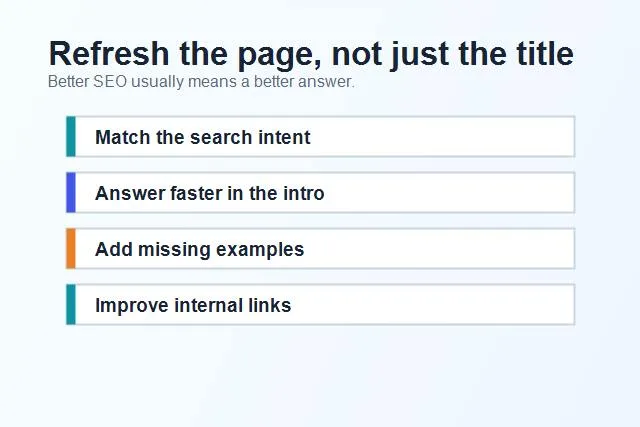
A useful page refresh improves the answer, not just the keyword placement.
Start by checking search intent. Look at the query you want to improve. Does the searcher want a checklist, definition, comparison, tutorial, product, local service, or troubleshooting guide? If your page format does not match the intent, small edits will not fix the problem.
Then improve the intro. The first 100 words should make the page feel immediately useful. Answer the core question early. Tell the reader what they will get. Do not make them walk through three paragraphs of throat-clearing before the page says anything useful.
Add missing sections. If top-ranking pages answer questions you ignore, your page may feel incomplete. That does not mean copying them. It means understanding what the topic requires and answering it in your own clearer, more practical way.
Add examples. Site owners learn faster from concrete examples than abstract advice. Show what a better title looks like. Show how to prioritize pages. Show what to check before changing content. This is one reason practical guides often beat generic "ultimate" posts that somehow say everything and nothing at the same time.
Finally, connect the page to related resources. If the page mentions page speed, link to a relevant speed guide. If it mentions on-page basics, link to your on-page SEO checklist. Helpful links make the site feel organized and give search engines clearer context.
Which technical SEO improvements matter most?
Technical SEO can get deep quickly, but most site owners should start with the problems that clearly affect crawling, indexing, speed, and usability.
Check indexability first. If an important page is blocked, noindexed, canonicalized to the wrong URL, missing from internal links, or returning the wrong status code, fix that before you polish copy. A page that cannot be indexed is not having an SEO problem. It is having an existence problem.
Fix broken links. Broken internal links create bad user paths and waste crawl attention. They are also one of the easiest issues to verify. A quick cleanup can improve both user experience and technical hygiene.
Improve speed where it affects real pages. You do not need to worship Lighthouse scores, but you should fix obvious Core Web Vitals issues on pages that drive traffic or leads. If your main image is huge, resize and compress it. If the page jumps while loading, reserve space for images and embeds. The Core Web Vitals guide breaks that down in plain English.
Clean up duplicate or thin pages. If many pages target the same intent, they can compete with each other. If a page exists but says almost nothing useful, either improve it, merge it, or remove it carefully. Do not let your site become a drawer full of half-written notes.
How do you measure SEO improvements?
Measure improvements by comparing the same page and query before and after the change. Use clicks, impressions, average position, CTR, and conversions when available. One metric alone can mislead you.
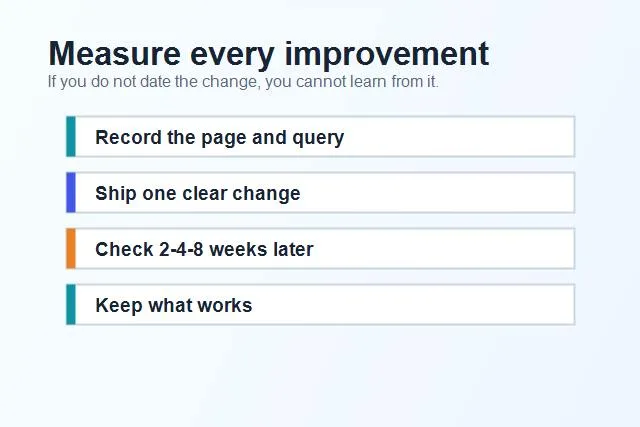
Every SEO improvement should leave a date, a reason, and a follow-up check.
If you changed a title and meta description, watch CTR and clicks. If you improved content, watch average position, impressions, and query coverage. If you added internal links, watch whether the target page gains impressions or improves for related terms. If you fixed speed, watch Core Web Vitals and engagement signals where you can.
Use a reasonable window. Two weeks can show early movement, but four to eight weeks is often more useful. SEO has lag. Google needs to recrawl, reassess, and compare your page against others. The internet is not a microwave, sadly.
Also avoid measuring only wins. If a change does not help, that is still useful information. Revert, revise, or try a different fix. The best SEO process is not perfect guessing. It is honest learning.
Common SEO improvement mistakes
The first mistake is improving pages without checking data. If you choose pages only by feeling, you may spend time where there is little upside.
The second mistake is doing too much at once. If you rewrite a title, change the H1, replace half the content, add ten links, and redesign the hero section all in one go, you will not know what caused the result.
The third mistake is chasing broad advice instead of page-specific fixes. "Write better content" is not an action. "Add a pricing section because searchers compare costs" is an action.
The fourth mistake is ignoring existing rankings. If a page is already close, help it. Page-two keywords and weak CTR opportunities are often easier than starting from zero.
The fifth mistake is forgetting the user. SEO improvements that make the page worse for humans usually do not age well. If the page becomes harder to read, slower to load, or stuffed with awkward phrases, you are not improving SEO. You are decorating a problem.
FAQ
How long does it take to improve SEO?
Small fixes can be made in a day, but search performance usually needs several weeks to show meaningful movement. Review important changes after two, four, and eight weeks.
What is the fastest way to improve SEO?
The fastest practical path is to improve pages that already get impressions. Start with page-two rankings, weak CTR pages, obvious technical issues, and important business pages with poor on-page basics.
Can I improve SEO without an agency?
Yes. Many site owners can handle the basics: audits, title and meta improvements, content refreshes, internal links, speed fixes, and Search Console tracking. An agency can help with scale, but you can make meaningful progress yourself.
Should I write new content or improve old pages first?
Improve old pages first when they already have impressions, rankings, or business value. Write new content when there is a clear topic gap that supports your main pages.
Final thought
Improving SEO is less about doing more and more about choosing better. Pick the page with a real opportunity. Make one useful improvement. Measure it. Then do the next one.
If you want help deciding where to start, use SerpCue's small business SEO tool to turn your site data into a short list of practical next actions. That is the kind of SEO work that actually gets done.