Will ChatGPT Recommend Your Website?
Nobody can make an AI assistant recommend you. But you can check the four mechanical things that decide whether it can read and cite your site at all.

You cannot make ChatGPT recommend your website, and any tool that promises otherwise is selling you something it cannot deliver. What you can do is make sure nothing stops an AI assistant from reading, understanding and quoting your site — and that part is entirely mechanical, checkable in about a minute.
This guide covers the four things that decide whether an assistant can use your site at all, how to check each one, and what to fix first. No theory about "AI ranking factors" that nobody can measure.
Can an AI assistant even reach your site?
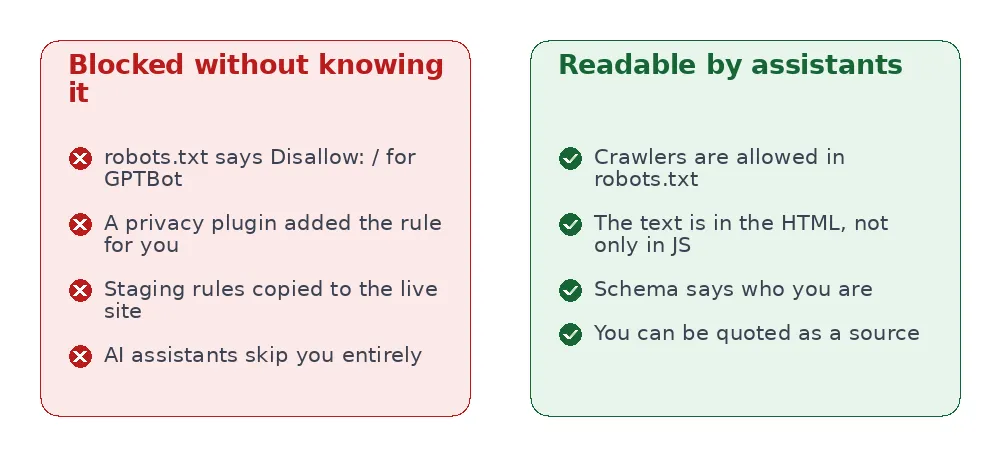
This is the one that catches people out. AI crawlers respect robots.txt, and plenty of sites block them without anyone deciding to. A privacy plugin adds the rule, a developer copies staging config to production, or a "block AI scrapers" setting gets switched on years ago and forgotten.
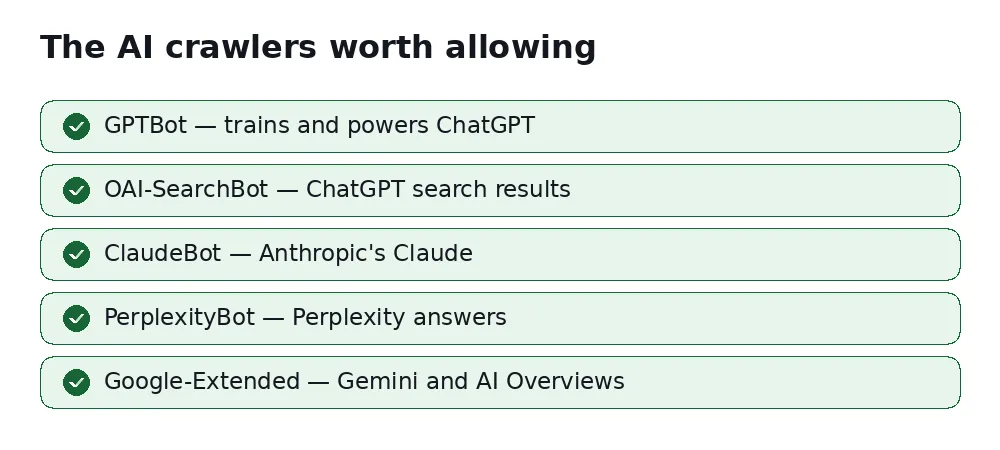
Open yoursite.com/robots.txt in a browser and look for these user agents:
- GPTBot — OpenAI's crawler
- OAI-SearchBot — the one behind ChatGPT's search results
- ClaudeBot — Anthropic
- PerplexityBot — Perplexity
- Google-Extended — Gemini and AI Overviews
If any of them appears with Disallow: /, that assistant is not reading your site. Neither is a blanket User-agent: * / Disallow: /.
Worth saying plainly: blocking them is a legitimate choice. Some publishers block AI crawlers on purpose because they do not want their writing used for training. The problem is blocking them by accident and then wondering why you are never mentioned.
Does your content exist without JavaScript?
Most AI crawlers do not run JavaScript. Google renders it; ChatGPT and Perplexity largely do not. So if your site is a React or Vue app that ships an empty shell and fills it in the browser, an assistant sees a blank page where your content should be.
Quick test: open your page, view source (Ctrl+U), and search for a sentence you can see on screen. If it is not in the source, it does not exist for a crawler that skips JavaScript.
The fix is server-side rendering or pre-rendering. That is a developer job, not a settings toggle — but it is worth knowing it is the cause before you spend time on anything else.
Does your site say who you are, in a format machines read?
When someone asks an assistant "who does pest control in Belgrade", it has to be confident enough about a business to name it. Schema.org markup is how you state that plainly: an Organization or LocalBusiness block carrying your name, address, phone and opening hours.
Without it, the assistant is inferring your identity from prose, and inference is where hedging comes from. With it, there is nothing to guess.
How does an assistant decide what to cite?
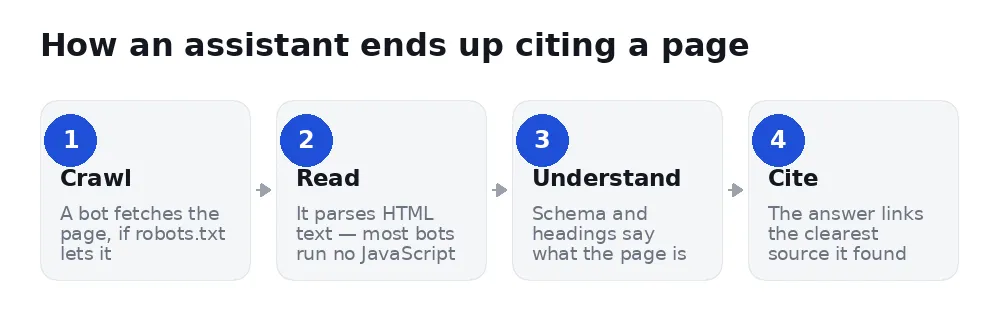
Simplified, but accurate enough to act on: the bot fetches what robots.txt permits, reads the HTML, uses headings and schema to work out what the page is about, and links the clearest source it found for the specific question asked.
Notice what is not in that chain: no keyword density, no backlink count, no magic. Clear pages that answer a specific question well are the ones that get cited — which is the same thing that has worked in search for years.
What about tracking your "AI rankings"?
Several tools now sell AI rank tracking: they ask ChatGPT about your brand and log whether you were mentioned. Treat those numbers carefully.
The same prompt can return different answers to different people, on different days, with different chat history. There is no single result page to measure, the way there is with Google. A number that moves for reasons nobody can reproduce is not a measurement, and building decisions on it is worse than having no number at all.
We deliberately do not offer AI rank tracking. We check the things you control and can verify: crawler access, readability without JavaScript, structured data, and whether you publish an llms.txt.
FAQ
Does blocking GPTBot hurt my Google rankings?
No. GPTBot is unrelated to Googlebot. Blocking one has no effect on the other. Google-Extended is the one that governs Gemini and AI Overviews, and it is separate from normal Google Search crawling too.
How long until an assistant knows about my new page?
There is no published schedule, and it varies by assistant. Some read the live web at answer time; others rely on an index refreshed on their own timetable. Anyone quoting you a number is guessing.
Is this replacing SEO?
No. Most of the work overlaps almost entirely: readable HTML, clear structure, honest content, correct markup. See GEO vs SEO for what genuinely differs.
Do I need an llms.txt file?
It is cheap to add and might help, but it is a proposal rather than a standard. We wrote an honest breakdown in What is llms.txt.
Check your own site
Our free page check reads your robots.txt, tells you which AI crawlers are allowed, whether the text survives without JavaScript, and what structured data you publish. No account, and it shows you everything it finds rather than hiding the results behind a sign-up.