How to Do SEO Yourself: Step-by-Step for Site Owners
A practical step-by-step guide to doing SEO yourself, from audits and keywords to content, internal links, and measurement.

How to do SEO yourself: start by making sure search engines can find your pages, then improve the pages that matter most, write content around real search intent, add useful internal links, and measure the results in Search Console. You do not need to do everything at once. You need a repeatable process.
That is the part most beginner SEO advice makes weird. It throws 47 tactics at you, then somehow expects you to know which one matters today. SEO is easier when you treat it like maintaining a useful website, not performing a secret ritual for an algorithm in a cave.
This guide gives you a practical step-by-step process for site owners who want to do SEO themselves without hiring an agency on day one.
Table of contents
- What does doing SEO yourself mean?
- How to do SEO step by step
- What should you do in your first week?
- What should you fix first?
- How do you measure SEO progress?
- What mistakes should you avoid?
- FAQ
What does doing SEO yourself mean?
Doing SEO yourself means improving your own website so search engines can crawl it, understand it, and show it for relevant searches. It includes technical basics, page improvements, content, internal links, and measurement.
It does not mean becoming a full-time SEO professional. It does not mean buying five tools before lunch. And it definitely does not mean changing your title tags every morning because a ranking moved from position 9 to 10 overnight.
For most site owners, SEO breaks into five jobs: make the site accessible, make important pages clear, answer real search questions, connect related pages, and track what changes after you make improvements.
If you can build that habit, you are already ahead of many sites that publish randomly, never check Search Console, and hope Google develops emotional attachment to their homepage.
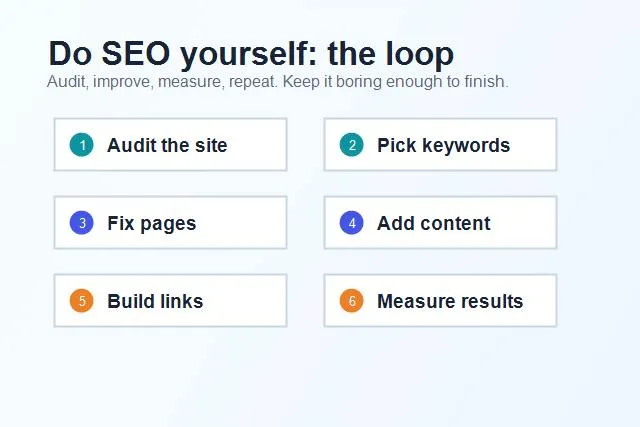
A simple SEO loop keeps you moving without turning the work into a giant mystery.
How to do SEO step by step
Start with the basics. Before writing new content, make sure your site can actually be crawled and indexed. Check that important pages return a 200 status, are not blocked by robots.txt, have clean canonical tags, and appear in your sitemap. If a page cannot be discovered, the best headline in the world will not save it.
Next, connect Google Search Console. It is free and gives you the search data you need: impressions, clicks, average position, pages, queries, and indexing issues. If you only use one free SEO tool, start there. SerpCue's check my website SEO workflow is designed around turning those raw signals into actions.
Then audit your most important pages. Look at the homepage, service pages, product pages, location pages, and any blog posts that already receive impressions. Each page should have one clear search intent, one clear H1, a useful title tag, a meta description that earns clicks, helpful headings, descriptive image alt text, and internal links to related pages.
After that, choose keywords by intent, not just volume. A phrase with 300 monthly searches and clear buying or problem-solving intent can be more useful than a huge keyword that attracts people who are just browsing. Ask: what would someone want if they searched this, and do I have a page that truly helps?
Now improve existing pages before you rush to publish twenty new ones. Existing pages often have faster wins because Google already knows them. If a page is ranking on page two, strengthen it. If impressions are high but clicks are low, improve the title and meta description. If a page has weak internal links, connect it better.
Only then build new content. New articles should fill real gaps: questions your audience asks, topics competitors cover better, or supporting guides that help your main pages. Each article should have a reason to exist. "The blog looked lonely" is not a content strategy.
What should you do in your first week?
Your first week of SEO should be practical and slightly boring. That is a compliment. Boring work gets shipped. Complicated work gets turned into a spreadsheet named final-final-v7.
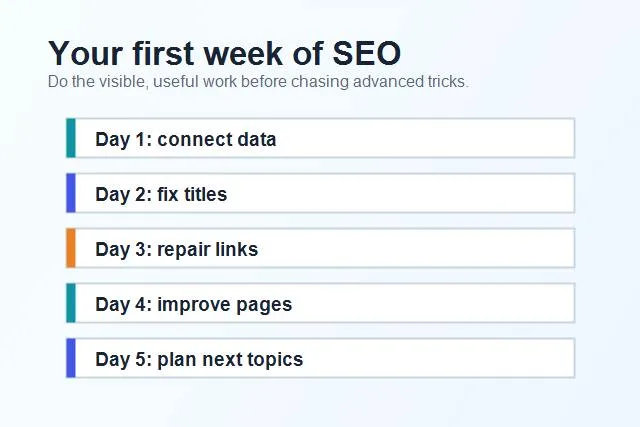
The first week should focus on setup and obvious fixes, not advanced tactics.
On day one, set up measurement. Connect Search Console, check that your sitemap is submitted, and list the pages that matter most to your business. Do not try to fix everything yet. You are building the map.
On day two, review titles and meta descriptions for priority pages. A good title tells searchers the topic, benefit, and fit. A good meta description explains why the page is worth clicking. This supports the same work covered in the on-page SEO checklist.
On day three, fix broken links and obvious crawl problems. Broken internal links waste user attention and make your site feel neglected. They are also easy to verify, which makes them a nice early win.
On day four, improve one important page. Add missing sections, answer the question faster, clean up headings, add examples, and link to related resources. One better page is usually more useful than five thin drafts.
On day five, plan the next two pieces of content. Choose topics that support your main pages. If you sell a service, your blog should answer the questions people ask before they need that service.
What should you fix first?
The best SEO task is not always the biggest task. It is the task with the clearest upside and the lowest reasonable effort. If a service page already gets impressions but ranks around position 12, that page deserves attention before a brand-new article with no data.
Use a simple priority filter: impact, confidence, effort. Impact asks how much the fix could matter. Confidence asks whether the problem is real. Effort asks how hard it is to ship. A high-impact, high-confidence, low-effort task should move to the front of the line.
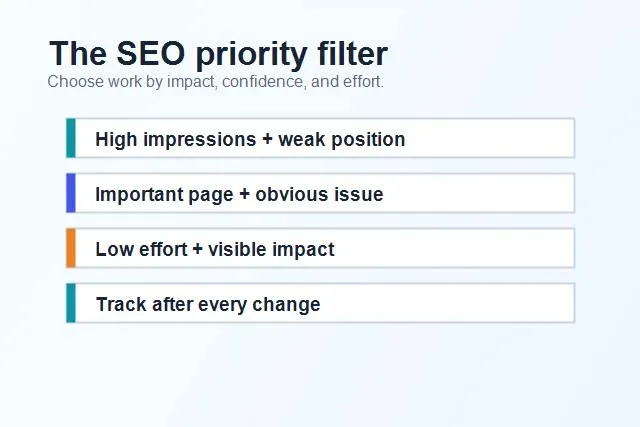
Good DIY SEO is mostly choosing the next useful fix instead of trying to fix everything.
Examples: a missing title on an important page is high priority. A huge uncompressed hero image on a high-traffic page is high priority. A low-value tag archive with no traffic might wait. A theoretical schema improvement on a page nobody visits can probably wait too.
This is where many DIY site owners get stuck. They read an article about canonical tags, then spend three hours auditing a page that does not matter while their main service page has a vague title and no clear CTA. Noble energy, wrong battlefield.
How do you measure SEO progress?
Measure SEO with a mix of clicks, impressions, average position, CTR, indexed pages, and conversions. Do not rely on one number. Rankings matter, but they move. Traffic matters, but it depends on seasonality and demand. Leads matter most, but they need enough search activity to interpret.
Search Console is the best starting point. Look at queries gaining impressions, pages that rank in positions 11-20, pages with high impressions but weak CTR, and pages losing clicks compared with the previous period.
Keep notes when you make changes. If you rewrite a title, improve content, add internal links, or fix speed issues, write down the date. Then check the next 2-8 weeks. SEO is not instant, but it should leave tracks.
Do not panic over daily movement. A page can move up and down while Google tests results, competitors update pages, or search demand changes. Look for direction over time.
What mistakes should you avoid?
The first mistake is starting with tools instead of pages. Tools are helpful, but they should point you toward action. If a report does not help you decide what to fix next, it is decoration.
The second mistake is publishing before improving. New content is exciting because it feels productive. But if your existing pages are unclear, slow, thin, or disconnected, new posts will not fix the foundation.
The third mistake is chasing only high-volume keywords. Big keywords are attractive, but they are often broad and competitive. A smaller keyword with a clear problem can bring better visitors.
The fourth mistake is ignoring internal links. Related pages should support each other. A new guide should link to relevant service pages, and older pages should link forward to useful new resources. If you want the practical version, read the internal linking guide.
The fifth mistake is expecting SEO to work without measurement. If you do not know what changed, you cannot learn what worked. That is how people end up doing random SEO cardio: sweaty, tired, and mysteriously in the same place.
FAQ
Can I do SEO myself?
Yes. A site owner can handle the core SEO basics: technical checks, on-page improvements, content planning, internal linking, and Search Console measurement. You may still hire help later for scale or advanced work, but you can start without an agency.
How long does DIY SEO take?
Early fixes can be shipped in days, but search results usually need weeks to show meaningful movement. For most sites, review changes over 4-8 weeks rather than judging them the next morning.
What is the first SEO task I should do?
Connect Search Console and audit your most important pages. That gives you both data and a short list of practical improvements.
Do I need paid SEO tools?
Not at the beginning. Free tools and a focused workflow can take you far. Paid tools help later when you need scale, competitor data, or advanced research.
Final thought
SEO becomes much less intimidating when you stop treating it like one giant project. Do one useful thing, measure it, and repeat. Fix the page that matters. Answer the question better. Make the next step clearer. Keep going.
If you want a practical starting point, use SerpCue to check your website SEO and turn the audit into a short action list. The goal is not to know every SEO term. The goal is to know what to fix next.